




Apple Cider Vinegar
(Andrews, Indiana)
05/11/2015
Hi Betty, Excessive use of ACV can cause lowering of potassium. Curious, however, is your potassium level of 5.6. I am diagnosed with a rare ion channelopathy and 5.6. is the serum level where I feel well. It is considered to be on the higher end of the normal range by my physician but still within normal parameters. Do you have symptoms with your potassium at this level? Such as weakness or partial paralysis? Malaise, headache or muscle tremors, fasciculations? For me these symptoms dissipate as I approach a level of 5.6 and begin to worsen as my potassium level decreases. In no way am I suggesting you may have this disorder. If you are not symptomatic at this level it just may be your bodies state of homeostasis. Of course certain medications such as an ace inhibitor along with a high potassium diet can cause you level to rise. I know for me I battle every day to try to keep my levels higher. I eat low carb, low sodium high protein and fat diet as it is recommended for my disorder, a type of normokalemic periodic paralysis. Even small decreases in my potassium levels can cause my symptoms to worsen. I take rather large amounts of potassium daily to obtain relief along with the ace inhibitor. My bodies homeostasis level is 4.4. I have been functioning as a hypokalemic individual all of my life until diagnosis even though my potassium has never been out of the normal range.
Apple Cider Vinegar
★★★★★
MY CONCLUSION.. MOST PEOPLE ARE LOW ON POTASSIUM..HAVE YOU EVER ASKED YOUR DOCTOR WHEN YOU TAKE A BLOOD TEST.. TO PLEASE CHECK YOUR POTASIUM LEVEL.. I DO NOT THINK YOUR DOCTOR WANT YOU TO KNOW THAT.. NORMAL LEVEL IS 3-5.. IF YOUR LEVEL IS LOWER THAN 3.. YOUR SICK.
THE REASON YOU FEEL BETTER WHEN YOU TAKE APPLE CIDER VINEGAR... ITS LOADED WITH POTASSIUM.
STAY WELL MY FRIENDS
ALFRED
EC: re: Potassium content of Apple Cider Vinegar
Bragg's ACV has only 11 mg of potassium per teaspoon (http://bragg.com/products/bragg-organic-apple-cider-vinegar.html)... quite a negligible quantity. A banana, on the other hand, contains at least 450 mg of potassium. If you're interested in increasing potassium, bananas are a better way to go!
(Msp, Mn)
11/17/2010
A Correction: Bragg's ACV has 11 mg of potassium per tablespoon not teaspoon.
(Rockford, Iowa)
05/03/2011
Bananas may be a great source of potassium but I suffer extreme gas and stomach pain. Acv is the best source of balancing stomach acid and maintaining health.
(Slc, Utah)
04/09/2015
Potatoes are one of the best sources of potassium when the skins are left on.
(Tx)
08/01/2017
Has anyone ever tried Cream of Tarter for a source of potassium? Cream of Tarter contains 450mg per tsp. the same as a banana.
The side affects is what bothers me. What are they concidering high doses? Side effects are unlikely when consumed in typical amounts found in food. However, taking it as a natural remedy may cause side effects that range from mild to life-threatening. (livestrong.com)
Because of its high potassium content, taking large amounts as a natural remedy may result in higher-than-normal potassium levels. Your body works to keep electrolytes like potassium in balance, and any disruption has a negative impact. (livestrong.com)
My wife some times has a problem with her potassium level dropping and will eat a banana to bring it back up. But we don't always have a banana when it hits her and I was wondering if it would be safe for her to take 1/2 tsp of Cream of Tarter mixed in some kind of liquid?
(Oh)
08/01/2017
Hi Paul,
A small 8.45 Fl. Oz. bottle of coconut water contains 500mg of potassium along with 4% calcium and 4% magnesium, so just a couple of swigs (not the whole container) of that would bring up her levels fairly promptly. They do not need to be refrigerated and can be taken anywhere, and keep in a pantry until the expiration date which can be a decent period of time. It can also be mixed with juice or smoothie ingredients. Best wishes.
Avoid Salt
★★★★★
Please note.. The minute the cell has more Salt than Potasium our bones in our back start to fall apart and we have back problems.. Please, Please eliminate regular salt from your diet, were ever it is.. In fast food, in soy sauce, in garlic salt, in container of salt.. We can live with out salt. Its Up to You.. Put only health stufff in your body. Alfred
(Michelbach-le-bas, Alsace, France)
10/22/2010
Hi Alfred, I have to say that apart from the sugar I couldn't agree less with you! Our bodies need fats, cholesterol and salt in order to function well! The fatless diets are a misconception of our society if you ask me! The only question is the kind of fats, some experts go for saturated fats and nothing but that, others go for vegetable oils.... Difficult to know who tells the truth...... My thoughts on that is that people always lived healthy on saturated fats and since vegetable oils (other than olive oil appeared) health issues became far worse so I know which fats I go for although.... A little doubt stays in the back of my mind! But no fats and no cholesterol... No! Read books like Trick and Treat and Fats and Cholesterol are good for you! Then you can make up your mind!
(Michelbach-le-bas, Alsace, France)
10/22/2010
One more thing, don't forget the liver makes a lot more cholesterol than we could ever eat so it is actually no use to eat less, you will only force your liver to make more. That said you are right the ration potassium/salt should be correct!
(Denver, Colorado)
03/11/2012
1 gram of wind and sun dried sea salt can be taken with 1 quart of water the excess sodium is removed from the tissues by the magnesium 1 tsp of trachang fish sauce contains 1/2 gram of sun dried sea salt the dosage is not per day but per quantity of water 1 tsp trachang fish sauce per pint of water several times a day is a very good remedy sun dried sea salt can be purchased from whole foods $1.69 for 24 ounces you can get 500 milligrams potassium from 1 tsp cream of tarter.
(London)
02/12/2017
The term vegetable oils, is actually a "misnomer", since most of these oils are seed oils; i.e. sunflower seed, sesame seed, rapeseed etc. All of which are not exactly healthy due to their Omega 6 to 3 ratio.
(South Carolina)
01/13/2018
Aflred, you have a lot to learn about nutrition. Until you experiment on yourself, please keep your incorrect assumptions to yourself. You could hurt unsuspecting and vulnerable people. After you have the know how, then you can have the pow wow. Until then, educate yourself.
Avoid Salt
Yes, our cells in our body are little electrical cells..Simple explanation .. is Mostly Potasium and a little Salt.
If you eat a lot of fast food and junk food, which is Loaded with Salt.. your killing your-self according to the USA Government finding.. An Article written in 1977.Just push into the computor..USA 1977 findings on excess Salt in our Diet.
Sooo what happens the Salt pushes the Potassium out of our cells and kills the cell.. then we get sick, very sick.
So Please stay away from Salt and take ACV Daily
Stay healthy
Alfred
(San Luis Obispo, Ca)
04/22/2010
I agree that processed salt, regular table salt as well as salt in commercially processed foods should be avoided. Sea Salt on the other hand as nearly 80 beneficial minerals that your body does need. The book Salt Your Way to Health, was extremely informative to me on figuring out how much and what kind of salt to use.
(Sahuarita, Az)
10/09/2011
I think Alfred should be referring to 'Sodium' instead of the catch all of 'salt'. After all, there are also uranium salts, amphetamine salts, boron salts, etc. "Salt" is a from, not technically a specific substance. The reason you hear that you should stay away from too much 'salt' is because common table salt was originally made by refinement for use as an industrial chemical and is almost pure sodium. So an over abundance of pure sodium without the minerals it is naturally found with causes an imbalance in your body chemistry. The natural substances of sea salt, Celtic salt, Himalayan salt, etc. have the correct balance of nearly 80 beneficial minerals (as Kelly from San Luis Obispo pointed out)
Chemotherapy and Depleted Potassium
★★★★★
Cream of Tartar
★★★★★
EC: Has anyone used cream of tartar medicinally? It's an old time remedy and we're discovering interesting information while researching it right now. Only side effect noted is gastrointestinal distress (diarrhea) if too much consumed in one day.
(Wellington, New Zealand)
04/13/2010
★★★★★
Reply to EC: 30 years ago I had a friend (now deceased) who was crippled as a young woman 20 years before with polio. She told me she took a teaspoon of cream of tartar in water every morning on rising and that this kept her "water" flowing in good order. I regret now I didn't clarify exactly what she meant, maybe having partial paralysis (she could manage on crutches) meant her bladder needed better control or to prevent any edema. She did mention that it was a remedy well known among her contemporaries. Hope this helps a bit.
EC: Thank you so much!
(Wellington, New Zealand)
09/28/2012
Hi, further to my previous post I happened to google cream of tartar and found many references to its use as a remedy for UTI's. This was probably what my friend meant when she indicated it for "water problems"
(-)
06/19/2013
To what I could gather one gram of CoT would have aproximately 200mg of potassium. (I used wikipedia for molar masses of CoT and tartaric acid). I weighed one tsp to be around 4 g (solid is about 5 g according to wiki).
So one tsp of CoT would contain around 800mg of potassium, if I'm not completely mistaken. One source (http://blog.fooducate.com/2011/01/11/8-things-to-know-about-cream-of-tartar/ ) said it would contain 495 mg of potassium. I packed mine quite densely though and my equipment isn't necessarily very accurate.
(La, Ca)
12/01/2013
Please correct your dangerously inaccurate information on this page regarding the potassium amount in cream of tartar. Other websites are quoting this information from your page, believing they are quoting a reliable source.
The reference on the page is this:
10/18/2009: Mortie from Pahrump, Nv: "For your minimum daily requirement of potassium take one level teaspoon of CREAM of TARTER - ABOUT 5 GRAMS as compared to 99 milligrams in a tablet."
That is incorrect. 1 teaspoon of cream of tartar contains just 11% of your daily needs, which is 495mg of potassium, not 5 grams -- that's a 10X difference. You can cite the following reliable sources:
http://ndb.nal.usda.gov/ndb/foods/show/5746
http://www.nutritionvalue.org/Leavening_agents, _cream_of_tartar_nutritional_value.html
(West Palm Beach, Fl)
12/09/2014
I took 1 tsp of Cream Of Tartar around 2 pm today and have been drinking plenty of water. I am still nursing my 2 year old son and I held off to do so until 8 pm. (about 6 hours later ) Ian concerned and now worried about nursing him. Does anyone have any input on this ? Will he be ok ? I tea about cardiac arrhythmia and am checking his bpm often. I would love some input. Thanks!
(Tennessee)
12/09/2014
Dear Diana,
I have not been able to find any information to say that cream of tartar would be contraindicated in breastfeeding. I checked my "Breastfeeding Answer Book" and could find no information about it. It was not listed in the table of foods and substances contraindicated during breastfeeding.
Personally, I would not be concerned. I was a nursing mom for most of 20 years and I don't think I would have thought twice about it.
But perhaps you have some information I am unaware of regarding it?
Your toddler is so blessed to still be nursing!
~Mama to Many~
(Utah)
12/03/2015
★★★★★
To Ann of La, Ca--Yes, a teaspoon of cream of tartar equals or contains 5 grams of cream of tartar, not potassium. A teaspoon of flour is also 5 grams of flour. No dangerous information was given. You misunderstood. It wasn't 5 grams of potassium. A teaspoon or 5 grams of cream of tartar contains 495 mg of potassium.
(Ca)
03/28/2017
Potassium doses should be split up into smaller doses throughout the day. I take 1/4 teaspoon of Cream of Tartar in 4 ounces of orange juice and a pinch of sea salt twice a day, at 10:00am and 2:00pm. It's called the adrenal cocktail. I feel more grounded with this added to my diet.
(Tx)
08/01/2017
Dana do you drink this everyday? My wife takes medication for High Blood Pressure and periodically she will suffer from her potassium level dropping too low. Most of the time she will eat a banana and then she will be fine in about 30 minutes. She had a spell last night about 1:00 am and we didn't have any bananas for her to eat. It was to late to go to the store and buy some bananas because we don't have 24 hr stores here. I saw on the internet about CoT but I was afraid to give it to her because of the warnings I read. She suffered about 1 1/2 hours because of it and finally went back to sleep.
(Wales)
10/27/2021
★★★★★
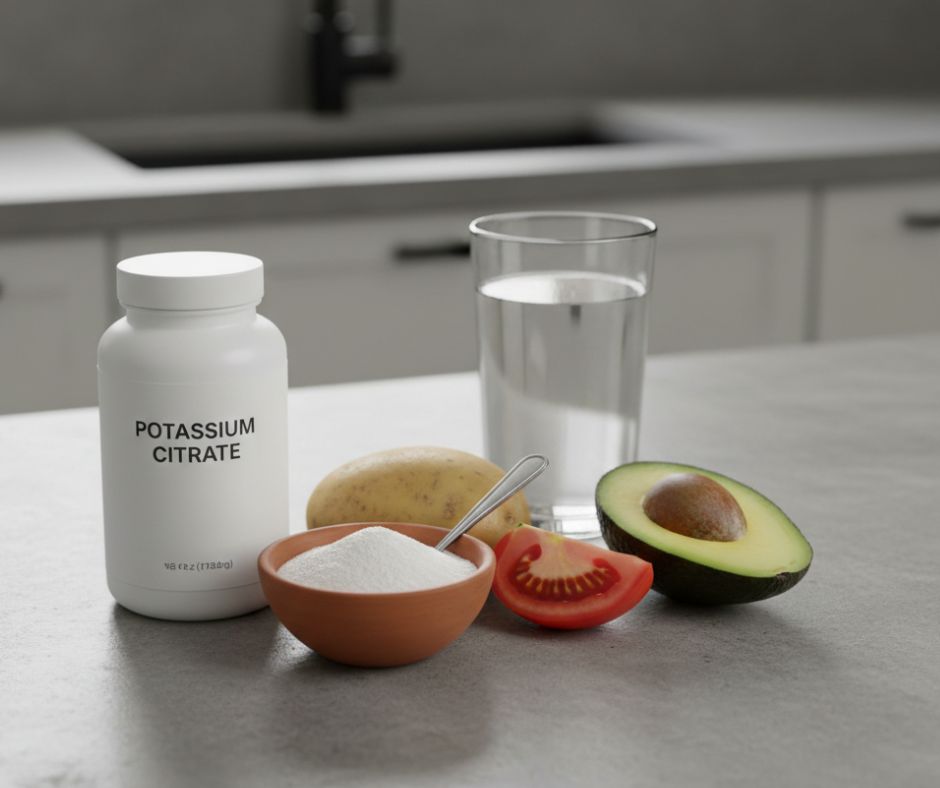
 As Dr. Berg points out on YouTube, a classic symptom of low potassium is hearing your blood/pulse whooshing or banging in your ears. I keep a pot of potassium citrate crystals by my bed & a quarter teaspoon in water gives me 300mg of elemental potassium, the amount in a small banana. As I don't want to be eating at night, I just pop some into half a glass of water along with half a teaspoon of magnesium citrate (magnesium helps the cells retain potassium, apparently), let it dissolve for a few minutes then drink it down. Stops the banging & calms me down within a few minutes. A level teaspoon of Cream of Tartar only seems to contain around 500mg of elemental potassium (the amount in a large banana), so shouldn't be an issue. A glass of coconut water contains a decent amount of potassium, so having some of that on hand is helpful too.
Eye Dryness
★★★★★
If you have had to deal with any of the COVD colds these past few years check with the doctor to find out if your potassium level is up to par. Besides Vitamin C and Melatonin, Potassium was one of the earlier supplements that helped people recover from COVD. From what I understood that condition used up or drained the body's potassium.
I am adding this thought on potassium because lately I have been trying keep up with the daily recommendation for Potassium. Articles say 3,500–4,700 mg of potassium daily and that it is safer when taken in foods. This really is not hard if you love banana, spinach, prunes etc. . However, knowing that I do not have enough potassium rich foods on hand, I take potassium supplements. I noticed that when I wake up in the morning, my eyes feel much more normal. In fact, sometimes I forget it has been sticking.
I could not find much information to verify this, but what I did come up with is in this post. I found a post from PubMed that incudes what tears are made of in this statement"
"Methods: The model is based on mass balances of water and solutes such as glucose, sodium, potassium, and chloride."
Check it out the PubMed Article:
https://pubmed.ncbi.nlm.nih.gov/17453939/
Here is an article about potassium Deficiency and dry eyes:
https://healthfully.com/347415-potassium-deficiency-and-dry-eyes.html
I have always been concerned about seniors, and now that I am one, I see and feel what they are saying.
HisJewel
Eye Dryness
★★★★★
Fatigue
★★★★★
Cut an unpeeled potato in slices in the evening and leave the pieces in water overnight. The juice, drunk in the morning, is rich in potassium. I read in a book that potassium deficiencies are common in people with fatigue.
Gout
★★★★★
High Potassium Levels
I so love this site even though a lot of it goes over my head. I wish smartness was contagious.
(Southeast USA)
04/22/2024
How do I lower high potassium level?
Ted (from Bangkok-RIP) suggested taking sea salt to lower potassium levels & I'm wondering if anyone has tried this & if using Himalayan salt would work. Also read some time ago that taking baking soda reduces potassium - anyone out there with high potassium levels have any suggestions??
Low Carb Diet, Lupus
★★★★★
(Houston, Texas)
04/13/2009
★★★★★
Dear Abby,
I have also been taking 5 tablets of potassium almost everyday. Like you I am one of those who need a lot of potassium. I have been doing this for 5 years now and am fine. Like you I have often worried about it but can't live without this amount. I have been told it is because of low stomach acid the mineral are not getting into the system like they should. I don't know if this is right but there is a reason. I am fighting fibromyalgia and in a lot of pain all the time so think the minerals are being use up in this way. But don't know for sure. Read up on Nano bacteria and mycoplasmas and fluoride posioning. I am working on all these levels. I can tell you addressing these will help but lots of patience is required. Earth Clinic is a good source of information that can help.
(Milwaukie, Or)
09/30/2010
★★★★★
I have low stomach acid too, I take 10 or so 99mg tabs of potassium per day. Iodine 2% drops about 20 per day helps with many other symptoms too, Lugol's brand in my drinks. I hurt myself by using superdieters tea and have needed much potassium suppliments from then on.
Muscle Fatigue
★★★★★
(Darien, Il)
04/27/2014
You most likely have low blood pressure because you have low potassium levels. So taking potassium should not lower your blood pressure more, it should help normalize your blood pressure instead. I had a hair analysis done in the past and it said my sodium/potassium levels were very low. It also said I had low blood pressure due to the low sodium/potassium levels. Yes potassium can lower blood pressure for those that have high blood pressure, but it shouldn't lower it more for those with already low blood pressure, it should just normalize it. Magnesium also lowers blood pressure too for those with high blood pressure and that also shouldn't lower blood pressure for those with already low blood pressure.
Muscle Shakes, Seizures and Cramps
★★★★★
Potassium Side Effects Remedy
★★★★★

